
“It doesn’t matter if your guests will not buy my gloves, just come and make sure to stay with me at least one hour or don’t come at all”.
Over nine years time, this would be the only answer that Mauro Squillace, a 4th generation glove maker in Naples, would give me when I was calling to organize a visit for my students or friends to his Omega glove factory. Located in the third no-elevator floor of an ancient building at the entrance of the Sanità district, his “factory” couldn’t look less than that, being more similar to typical neapolitan apartment when a bunch of employees (family members for Mauro, some of which have been working since Mauro’s father was in charge) would be very busy in the final production steps of the last 100% made in Naples leather gloves, the only ones that, in Mauro’s words, survived the era and the temptations of globalization.
About this Mauro used to say: “I don’t like to send e-mails: even at times of globalization a phone call before or a shake of hands later are always the best contract”.
When I first met Mauro he couldn’t speak any English, while of course he was fluent in French because of his frequent relationships with Paris. And so our visits to Omega would always sound like a cabaret show with me trying to translate whatever came to his mind, from the glorious past of the Bourbon kindgdom, to jokes in dialect, to the smallest technical detail of glove making. In a few years Mauro would not need my translation anymore, he would explain everything in his perfect Neapolitan – English (even the jokes) and I could relax and enjoy the show with my guests. Students and visitors were so fascinated by his passion and competence that we always ended up to spend there the double of the scheduled time, with a good 30 minutes in buying those wonderful pairs of gloves. Meeting Mauro was for my students the first very original encounter with the best that the heart of Naples could offer, beyond the beauty of the post-card stereotypes. Mauro was a gentle, proud Neapolitan, a skillful, honest, stubborn hard worker, a life lover with a great passion for food, motorbike and Massa Lubrense sea.
Well, Mauro Squillace just left us, in silence, after over one year of struggling with a bad cancer, a situation that noone but the closer members of his family were aware of. Alberto, his right arm and beloved son – today the new Omega manager – gave me the sad news a few days ago, saying it was Mauro’s will to keep this silent and to keep humbly working and enjoying life as always, as if the beast was not there. I took it as charming Mauro last joke, a bad one in this case, and I tried to smile reminding a picture on his desk of him embracing his beloved daughter Martina – today a young designer in Paris – and Alberto, and of the good life example he has left to them and to all of us in heritage. Napoli just lost another great ancient soul. So long, my dear friend, and long live Omega.
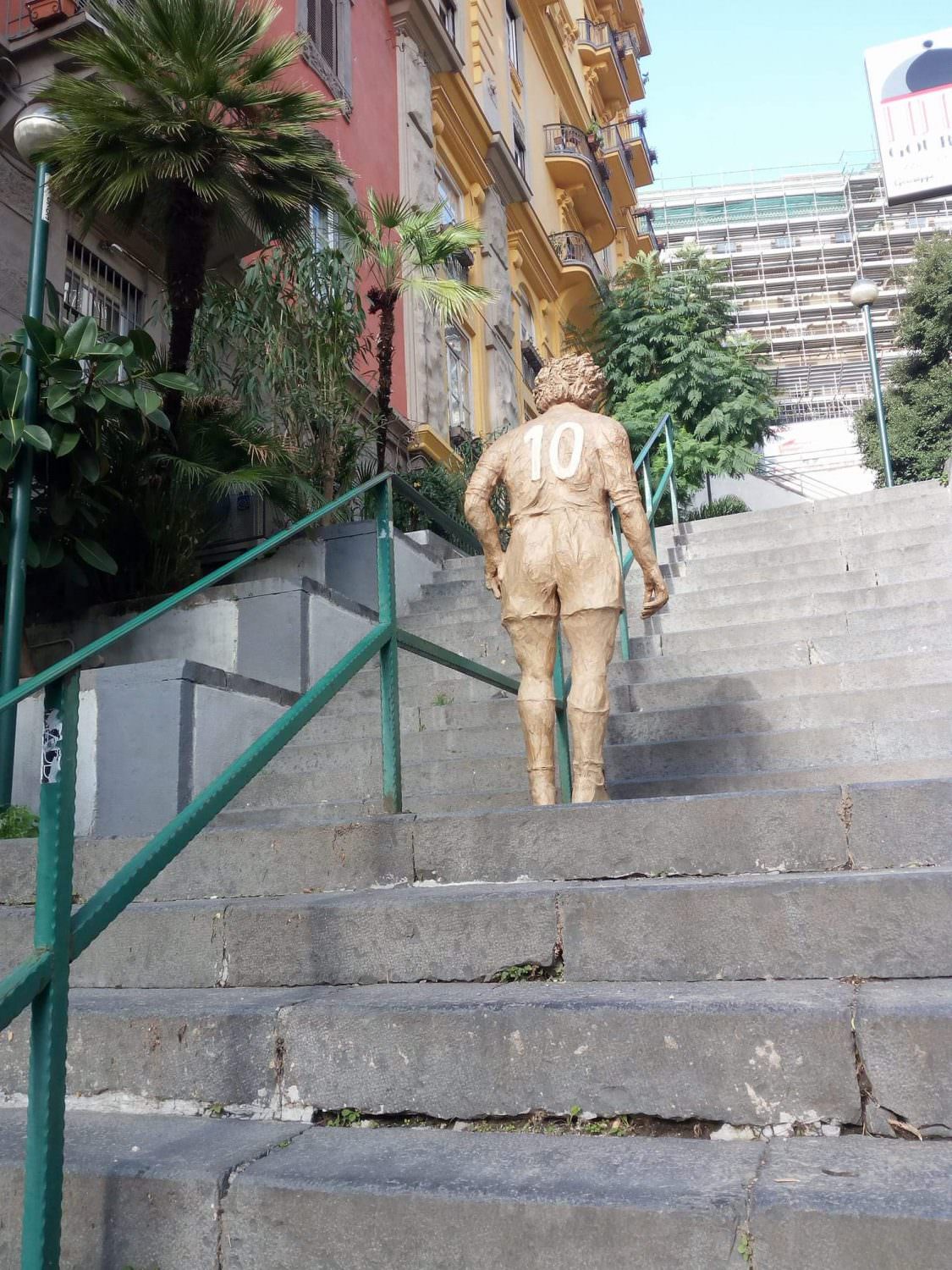
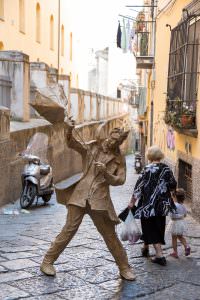
 Since they have been a fixed couple they have a mission: to tell the values and traditions of Naples through art and creativity. So they joined forces and in the Teatrino of Perzechella, in Vico Pallonetto in Santa Chiara n.4, many young people arrive, from all regions of Italy and also from abroad, to learn the secrets of chocolate art (white, milk, and dark chocolates) and traditional music; and to take part in the “Marenna and show” (in Neapolitan Marenna would be bread with meatballs or eggplants).
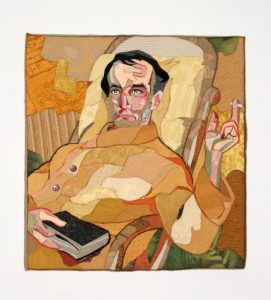 the sinuous and sensual fabrics, which under the expert hands of two Neapolitan artists take the form of beautiful paintings.