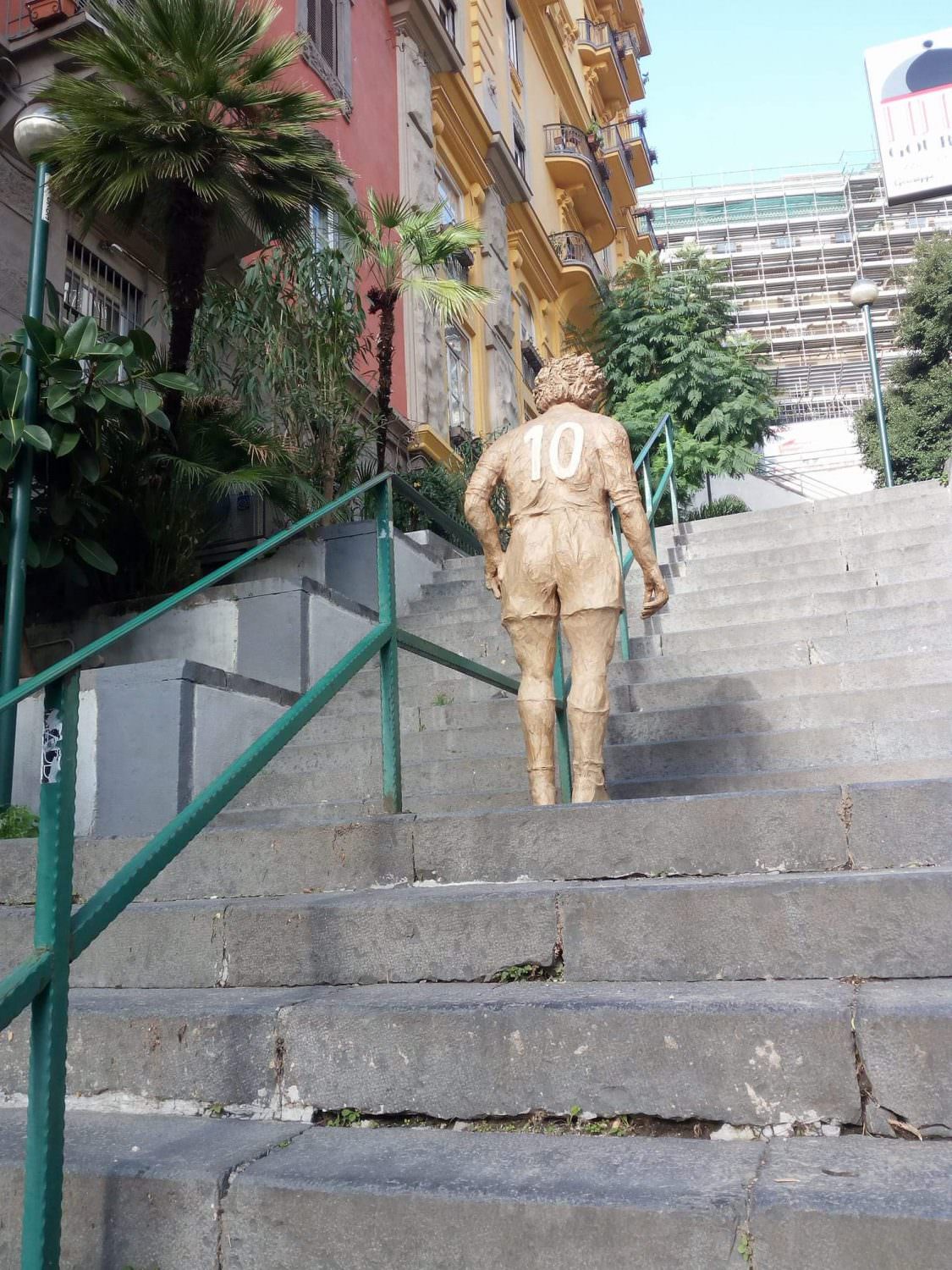
The Neapolitan artisans who make crib figures are famous all over the world, but not all of us have had the surprise of coming across life-size figures. The characters of the Neapolitan theater like Eduardo De Filippo, overlooking a balcony in Via dei Tribunali and the famous soccer Diego Armando Maradona walking in the street; or ordinary people walking through the city: a beautiful woman walking through Piazza del Gesù, a man with an umbrella in the wind in Piazza San Domenico Maggiore.
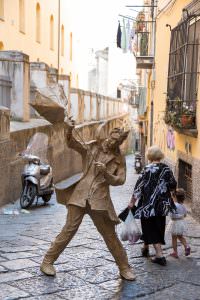
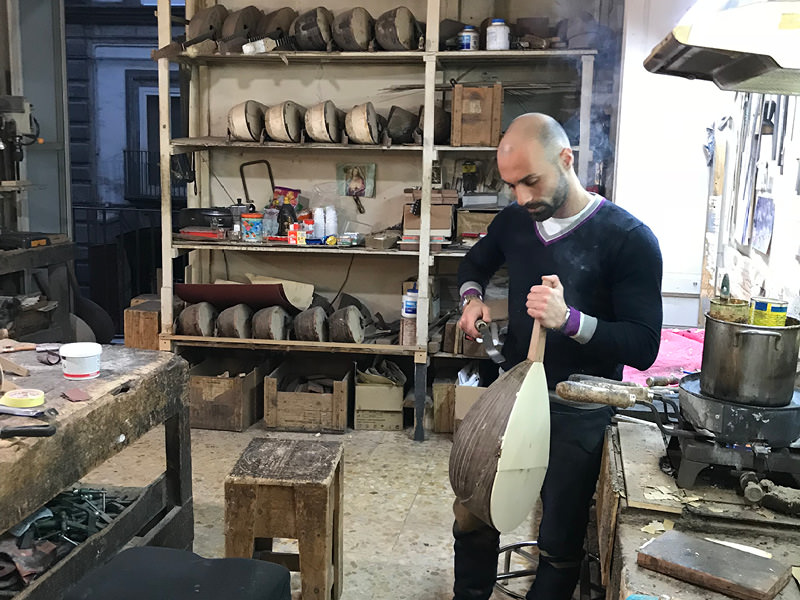
These marvelous figures seem to be made of wood or even marble, but this is not the case because the material used by the craftsman who makes them with passion is papier-mâché: it can be very strong but also very lightweight. What is papier mâché or cartapesta? The Italian tradition of Cartapesta dates back to the late 1600’s. It had its origins in Naples with presepe (nativity) figures as well as the life-size models of saints made for Holy Week processions, lighter to carry than wooden statues. If you want to see these life-size figures you can go to Claudio Cuomo’s laboratory, one of the best Neapolitan artists. His masterpieces are exhibited in many art galleries, but you can also find them around the city.

“The technique is very simple – says Claudio Cuomo- I start with giving volume with the paper and some sheets soaked in the glue, then I work with my hands. It’s a job that you learn by doing it. I also learn from mistakes, which are part of the creative process “. And so he invented the child with the balloon, the colorful fish, revisited the classic horns to wish good luck to friends.

claudiocuomosculpturesdrawings

Tonia Limatola

My blog tonialimatola.wordpress.com/
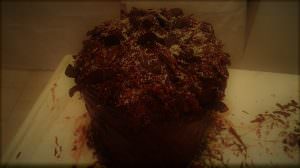
 

Her motto is “si vu ‘fa’ e Napule .. ‘nu muorzo!” (if you want to bite Naples) And she prepares chocolate as it once was done, proudly by hand and with lots of love. Pina Andelora (her nickname perzechella means small peach) had a small factory in the historic center of Naples, then it became a place of culture with the name the “Teatrino di Perzechella”. What happened? Eight years ago he met the man of his life: a street artist, Angelo Picone, better known as’ the Captain. Chocolate maker Pina, master of tammorre Angelo.  Since they have been a fixed couple they have a mission: to tell the values and traditions of Naples through art and creativity. So they joined forces and in the Teatrino of Perzechella, in Vico Pallonetto in Santa Chiara n.4, many young people arrive, from all regions of Italy and also from abroad, to learn the secrets of chocolate art (white, milk, and dark chocolates) and traditional music; and to take part in the “Marenna and show” (in Neapolitan Marenna would be bread with meatballs or eggplants).
If you want to conquer someone, rely on Perzechella who will advise you with what kind of chocolate to drive it crazy someone for you. The sfogliatella cream? The liqueur? Chocolates in the shape of a cup of coffee? In short, you have only to choose and fall in love immediately.

Tonia Limatola

My blog tonialimatola.wordpress.com/


Do you have your own collection of sand at home? Glass bottles filled here and there, to remind you of having been lying down in the heat once. Or keep dear in the bookshop “La collezione di sabbia” by Italo Calvino. Good. These are the prerequisites for entering the magical world of “ilfilodipartenope”   and meet Lina Marigliano and Alberto D’Angelo in via Costantinopoli, in Naples. Good. This year the project of these two artisan publishers is 15 years old. Books are precious objects, those who love reading know it well. But the little treasures that Lina and Alberto propose us steal the material from the earth.

Alberto & Lina

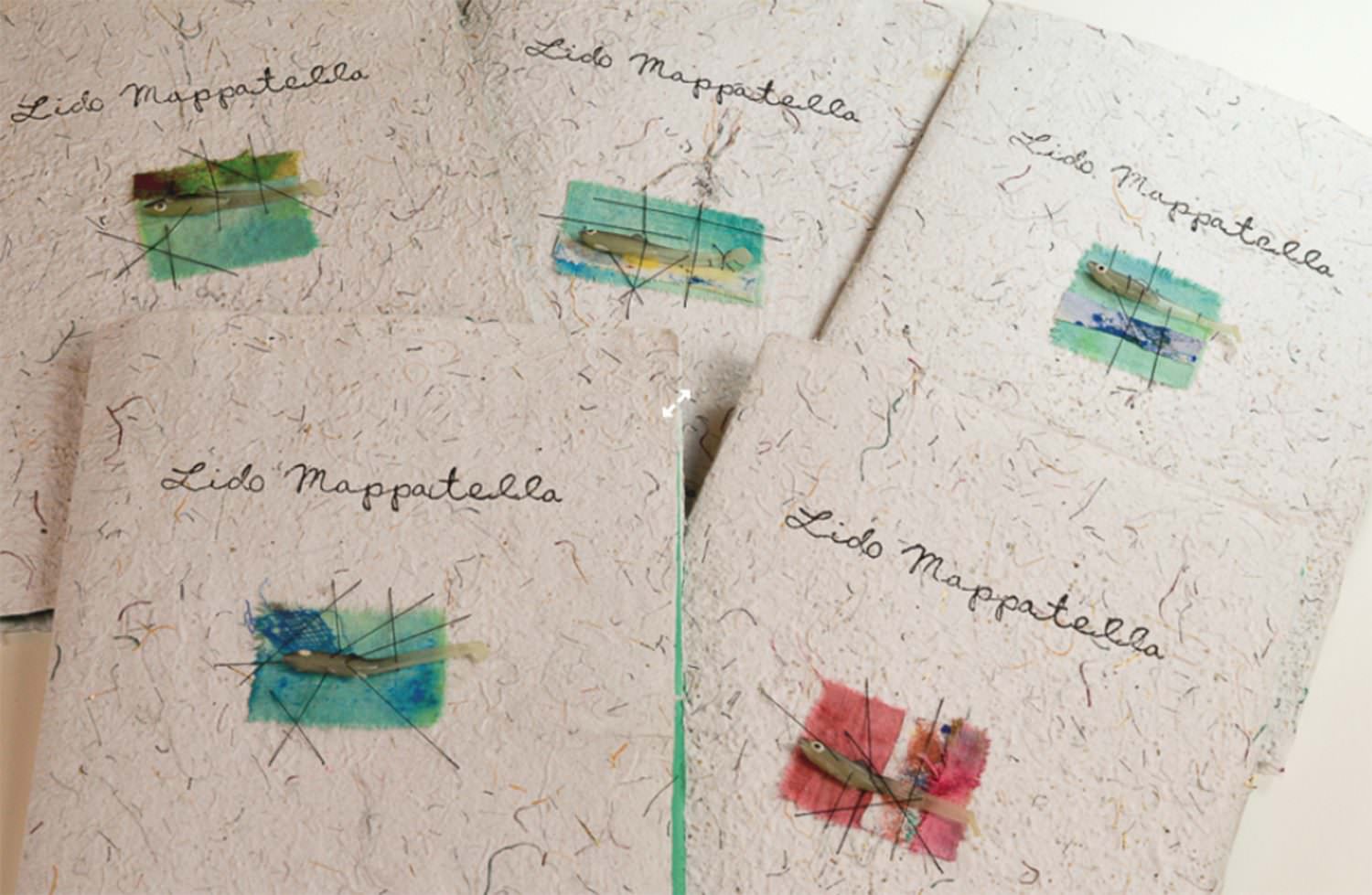
“Collection of sand”, for example, (the reference to Italo Calvino is shameless) collects texts on Italian coasts and seas (thirteen titles until now), with covers made with sand from the places to which the verses are inspired. It’s incredible, is not it? “We wanted to create a poetic geographic atlas, we wanted to tell the places through fragments of writing and covers of the matter of the places they tell,” explains Lina. Minor limited editions, small masterpieces.

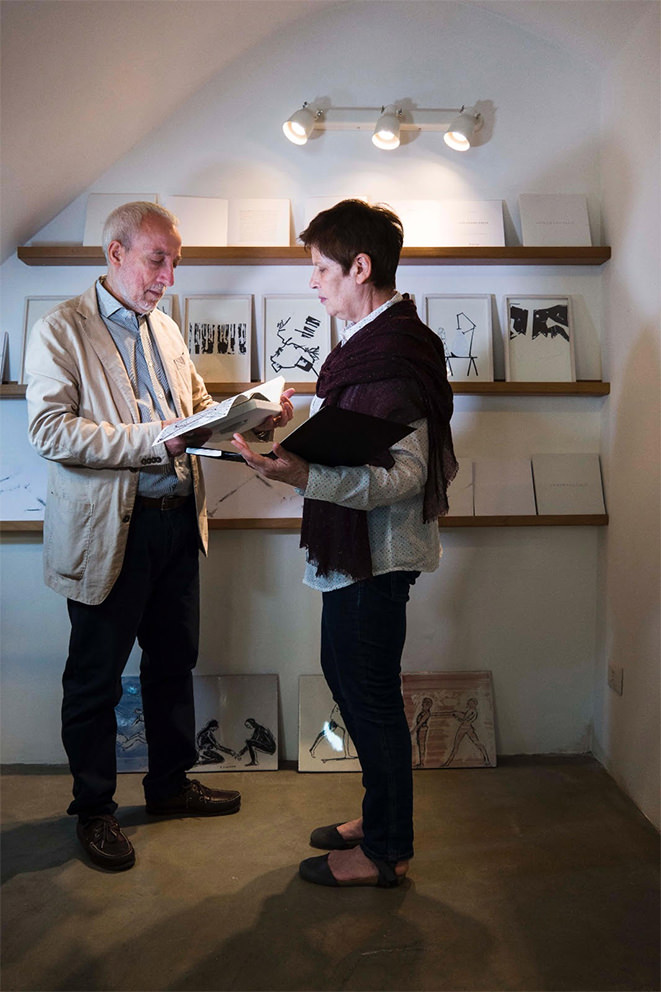
“Books are born from books – Lina continues -We always read, ours is a continuous reading exercise. There are those who do it through the photos and who through the written word. The result is a continuous cultural growth. The result is beautiful, but for us the path through which the project develops is more interesting”. Their store is more like an art gallery than a bookshop.

Eighty projects in book form. From the first “Tufo” by Erri da Luca with an etching by Vittorio Avella, to the last “365 Il giorno del pane” with original photographs by Antonio Biasiucci and a novel by Stella Cervasio, in competition for the prestigious “Fedrigoni Top Award 2019”  www.fedrigonitopaward.com

And Lido Mappatella with a handmade paper cover kneading cotton fibers with sands and ragged pieces. The text is by Enza Silvestrini printed on straw paper and with a unique copy portrait made by Enrico Pulsoni.

Then, “CUM GRANO SALIS” with texts by Luigi Trucco from a literary tale extracted by Nico Orengo and with 7 serigraph plates by Vincenzo Rusciano.

Tonia Limatola

My blog tonialimatola.wordpress.com

Working in a company like Omega is a bit like being teammates: in order to win the match, and make every day the best gloves in the world, you need that every team member gives his 100%.
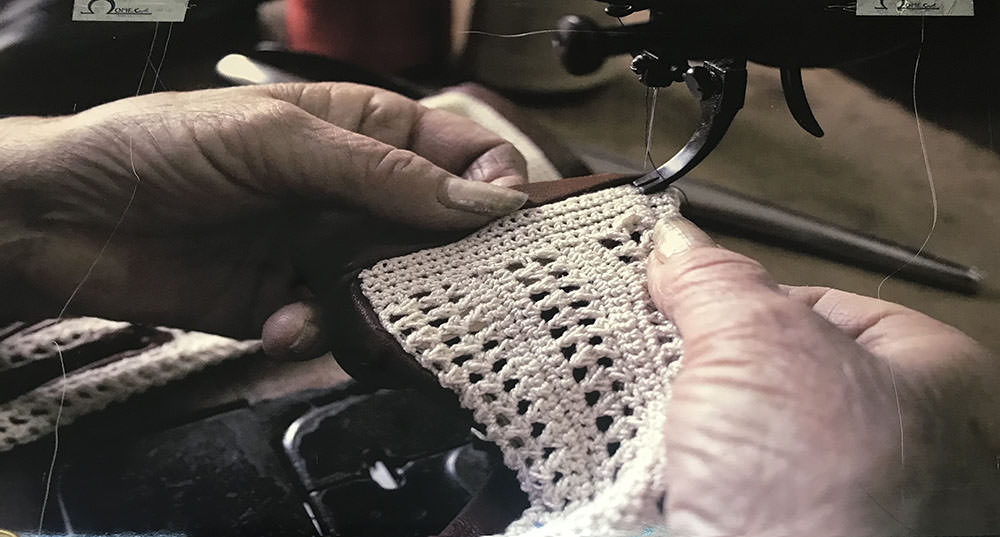
When I visited Mauro Squillace’s manufactory, it was explained to me that these magnificent gloves need 25 different working phases in order to be made. It wasn’t this information to impress me, though.
Don’t misunderstand me: 25 phases are a lot. And if you calculate the manufacture of the raw leather too, it reaches over 30 phases. Incredible!
However, what actually hit me more than anything else was that all these working phases are made by as many workers.
Can you imagine it? The perfect assembly line.
Heritage

Moreover, Mauro told me something else: each of the ladies who work for Omega had her own ability in heritage. Her mother taught her how to sew, how to cut, how to handle the leather. And her grand-mother taught it to her mother! It’s an heritage jealously preserved, whose effects have repercussions on the entire district, on the whole city.
Because if it’s true that the glove manufactory in Naples is the best in the world, it is thanks to these ladies who handed down their work techniques to their daughters.
And if you have the luck to go and visit Mauro with esplora Napoli, he will perfectly explain to you:

Each of these ladies sews with her family technique and will never sew in any other way!

Can you understand what a treasure is it?

The Nativity scene (that we Italians call presepe) is an incredibly ancient Italian tradition.
According to the legend, Saint Francis of Assisi designed it in the village of Greccio, when he was back to Italy from his journey to Sacred Land.
Believe it or not, what is certain is that in the Middle Age this practice diffuse very quickly, and during the Christmas period every church in Italy built its own crib which were object of prayer of the faithful. Naples wasn’t an exception of course.
It was during the 18th century, however, that Naples became the city of cribs, thanks to a simple and ingenious idea: Jesus wasn’t born in Bethelem 2000 years ago, but in Naples in the 1700’s.
The Nativity scene was inserted into representations of Neapolitan popular life. Next to the hut there are butchers and bakers, small alleys and folks; and above everything, dozens of colorful twinning angels.
From that moment, not only churches, but every house had its own crib, making many artisans open their shop.
Furthermore, Neapolitan presepe reached an unbelievable artistic quality, because of the fact that from about a century Naples welcomed the most modern artists in Europe.
In addition to the religious meaning that the crib delivered and still delivers, it became a way for everybody to effort a work of big artistic value, and keep it at home.

Neapolitan presepe today

If you walk through the historic center of Naples, you will find many shops which still today make tiny statues for Nativity scenes.
However you have to be careful!
Because if it is true that some of these artisans are true artists, other ones do nothing but sell and sell low quality pieces. Or, even worse, they make horrible caricatures of people from politics, from television, and from sports.

Traditional but modern

Ulderico Pinfildi is different from anyone else, and you will notice it as soon as you will come into his shop.
You will feel like in a small art gallery, surrounded by his magnificent pieces of art that he very often exhibits in museums all over the world. Certainly not by chance.
If you will have the luck of visiting his shop with esplora Napoli, besides, you will find out how his creations come to life and, listening to him, you will find out also the study and the thinking he devotes to his cribs, in order to do justice to such an ancient art that still has something to say.

Who’d have thought that in the center of one of the folk districts of Naples, on the top floor of a dilapidated building, in a untidy and smoky office, there was such a manufactory…?
We always hear that Naples is a city with one thousand contradictions: I never found this expression so fitting like when I visited Mauro and Alberto Squillace’s laboratory.
Among the alleys of the Stella district, one of the most sadly known because of the chronicle facts, there is a specialized manufactory: one of the highest level ones in Naples.
What am I saying? Not “in Naples”, but in Italy.
Even better: in the world!
I’m not kidding, and absolutely I’m not going too far.
I challenge you to browse a fashion magazine coming from anywhere: Germany, US, France, Japan…
There is a huge chance that the gloves worn by the models in photos came from the Stella district, from that smoky office.
To be honest, not all the 25 working phases needed for the production of those fantastic gloves are made there: several shops and offices are spread all over Naples and its province, but you can be sure that every snippet of leather, every sewing, every complete pair of gloves will be checked one thousand times by the masterly look of Mauro, the boss.

Mauro Squillace, the first among his artisans

When you will come into the office of Omega thanks to esplora Napoli, you’ll be welcome by Mauro Squillace, the owner of Omega.
You will immediately realize how kind (and chatty) person he is; but you’ll also realize something else.
You’ll understand that he is not just the boss of the company his grand-father founded almost one hundred years ago, but he is also the leader of his artisans team.
He knows each of the 25 phases his magnificent gloves need, and he deals with the most tricky ones.
He’ll show you anything! And you will seriously understand how much labor, how much work and, above all, how much knowledge are required for a product touching the art piece.

That’s a question we often ask when we face a good artisan’s work.
A good carpenter, a good tailor, a good shoemaker, a good ceramist can make pieces of work so good to make us believe they are artworks.
But art is an important word; a tough one.
You can’t pronounce it lightly

So, when can you actually speak about art?

Can you do it when the artisan does his job with passion? Yes, but it’s not enough.
When the artisan puts his soul into his works? Yes, but it’s not enough.
When the artisan can use masterfully hard techniques, passed down to him for decades, or centuries? Yes, but once again that’s not enough.
In my opinion, handicraft raises to art when the artisan put into play something more than his ancient techniques.
It’s art when he keeps studying critically his works, learning from the past great artists’ works, and when he reworks what he can already do in order to create something absolutely unique.

Just one word: thinking

All this can be summed up with one word: thinking.
Thinking makes art different from handicraft.
An artisan, as far as he’s good, as far as he does have golden hands, is little more than a pure performer of techniques learnt in many hears of work.
And, of course, I’m not denigrating artisans work. Handicraft has always been fulcrum of civilities.
But an artist make a different job; more cerebral, more intellectual.
If you ask Ulderico Pinfildi what is his job, you will answer you

I’m an artisan, I make puppets.

But do yourselves a favor: go and visit his workshop with esplora Napoli, and you will understand how wrong he is.

It often happens that the most authentic features of the culture of an area, if particularly stimulant, go around the world, become famous, are known by anybody.
If on one hand that’s surely positive (it’s one of the miracles of the age we live in), on the other hand it makes these features lose their contact with the background they were born in, risking to be trivialized.
It is a necessary evil, but an evil anyway.
And A dinner, center of an universe by esplora Napoli fits in this very crack.

Music, food, scenery

Music and cuisine are two aspects of the Neapolitan culture that, more than others, managed to be vital, young, modern over the centuries. Maybe it’s for this reason that they conquered the heart of anybody in the world: who doesn’t know pizza? Who doesn’t know ‘O sole mio?
But it is not enough! The experience esplora Napoli offers, makes its guests could know the authenticity, the history, the background of these two fantastic aspects of the culture of this crazy city.
All this in a breathtaking scenery.
Posillipo hill for millenniums gives people respite from the pains of everyday life. After all it’s in the etymology of it’s very name: Pausilypon, in ancient Greek, means who gives respite from sorrow.
It’s a fabulous combination: the fantastic traditional dishes reinterpreted by a great chef; the music played by great artists and told by an expert of its history; and a terrace that will make you fall in love at first glance.

Art is always alive. That’s in human nature itself.
We admire, we study, we know the art from the past and the huge personalities that conceived it.
But artists never die!
Let alone talking about a city like Naples. A city always alive and attentive to the inducement that the world gives to it.

Bruia

And Bruia is a glaring example of this phenomenon.
No projects, no materials, no ideas are too much to her; and you will notice it walking through her house.
Her house won’t show you only the space where an artist conceives and produces her pieces of art.
No way!
Bruia’s house is the most authentic product of her work. The Neapolitan artist has a deep link with it; maybe deeper than the link we all have with our own houses.
The rooms of the house take shape from her imagination, and her imagination gets ideas from her house. It’s a never ending loop that the guest will immediately catch.

Creativity is everywhere

A creative mind can invent something in every scope. That’s why the experience by esplora Napoli includes also a supper that Bruia in person will cook for her guests.
Neapolitan cuisine is famous all over the world and, despite it has its strict rules, it lends itself well to fantasy and ingenuity. After all it couldn’t be otherwise for a people like the Neapolitan one.
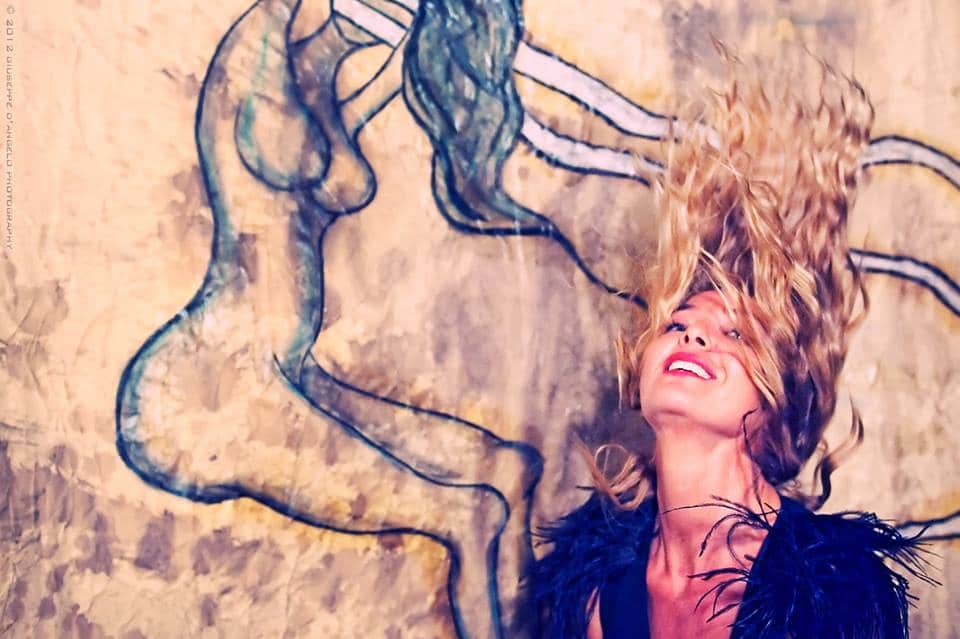
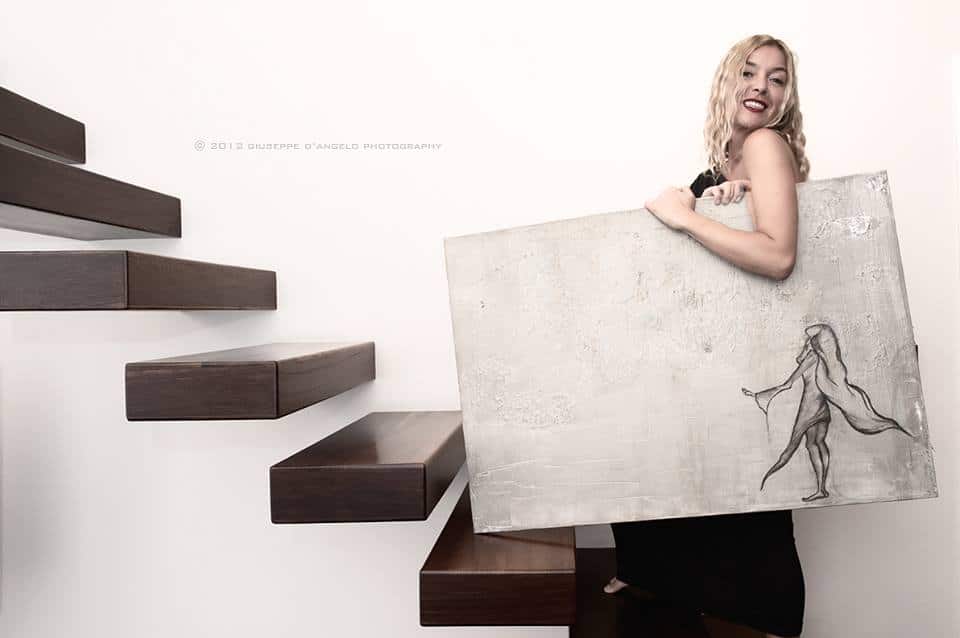
So Bruia proves to be daughter of her land: if you don’t catch it from her artworks (and I doubt it), you will surely realize it from her dishes.

Of course, Bruia’s house is furnished with style, and who is an entirior design enthusiast will notice it.
He will also notice with one look that every room was conceived by the same person and that, even if some combinations could seem weird and extreme, they make sense all together.

Strange rooms

What the guests of esplora Napoli will immediately notice, as soon as they set foot in Bruia’s house, is a strange wall of the kitchen. A wall with weird tints.
I do not want to reveal which material that peculiar wall is covered with, and the reason of those colors both pleasant and unpleasant. What I can ensure about is that anybody will want one in his house.
And walls are not the only uncommon things. The combination of magnificent antique pieces and Bruia’s creations show an extraordinary taste.
Indeed none could consider inelegant the combination of an ancient industrial bellows and a Christmas decoration

that I didn’t disassemble because it’s so beautiful

or a wonderful couch dating back to the last century in a room with a very modern glass bookcase.

An extraordinary place

Of course these rooms are magnificent: it cannot be denied. But there is another space that most of all deserves to be visited; and not because of the light and the elegant pieces of furniture.
I mean Bruia’s laboratory.
During the visit through her house, the neapolitan artist will bring her guests in a room with a low ceiling, semidark, maybe a little stinky too. But, among all the room, none will be more interesting.
Be careful not to stumble in dozens of unfinished pieces of art, left on the floor waiting for new ideas.
Pay also attention to the way Bruia touches he creations. She studies them, watches them with endearment and makes love with them.
You won’t be able to get away from there anymore.