Do you have your own collection of sand at home? Glass bottles filled here and there, to remind you of having been lying down in the heat once. Or keep dear in the bookshop “La collezione di sabbia” by Italo Calvino. Good. These are the prerequisites for entering the magical world of “ilfilodipartenope”   and meet Lina Marigliano and Alberto D’Angelo in via Costantinopoli, in Naples. Good. This year the project of these two artisan publishers is 15 years old. Books are precious objects, those who love reading know it well. But the little treasures that Lina and Alberto propose us steal the material from the earth.
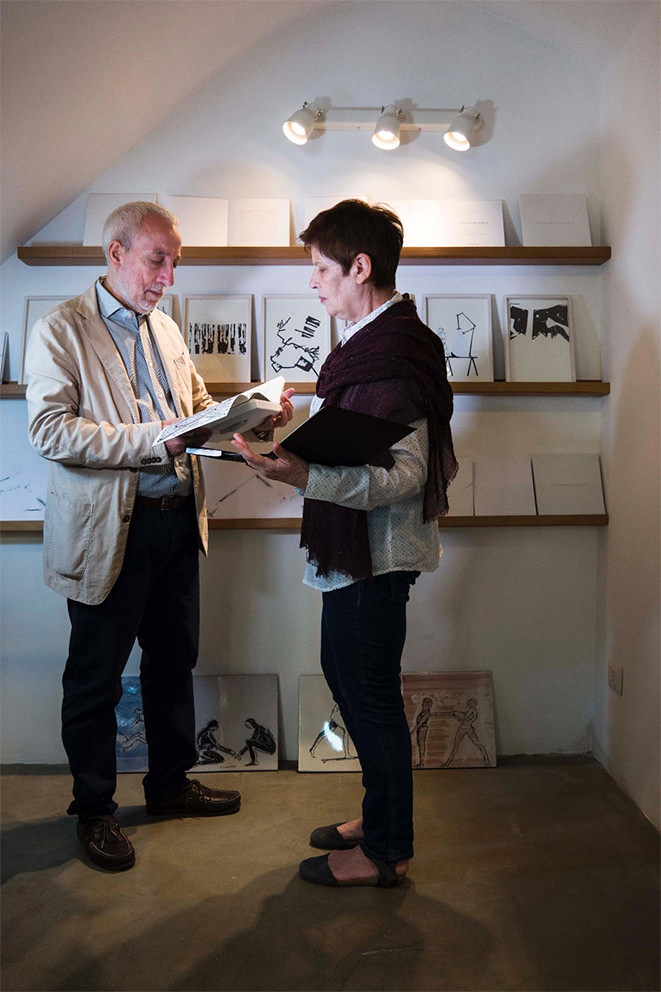
Alberto & Lina

“Collection of sand”, for example, (the reference to Italo Calvino is shameless) collects texts on Italian coasts and seas (thirteen titles until now), with covers made with sand from the places to which the verses are inspired. It’s incredible, is not it? “We wanted to create a poetic geographic atlas, we wanted to tell the places through fragments of writing and covers of the matter of the places they tell,” explains Lina. Minor limited editions, small masterpieces.

“Books are born from books – Lina continues -We always read, ours is a continuous reading exercise. There are those who do it through the photos and who through the written word. The result is a continuous cultural growth. The result is beautiful, but for us the path through which the project develops is more interesting”. Their store is more like an art gallery than a bookshop.

Eighty projects in book form. From the first “Tufo” by Erri da Luca with an etching by Vittorio Avella, to the last “365 Il giorno del pane” with original photographs by Antonio Biasiucci and a novel by Stella Cervasio, in competition for the prestigious “Fedrigoni Top Award 2019”  www.fedrigonitopaward.com

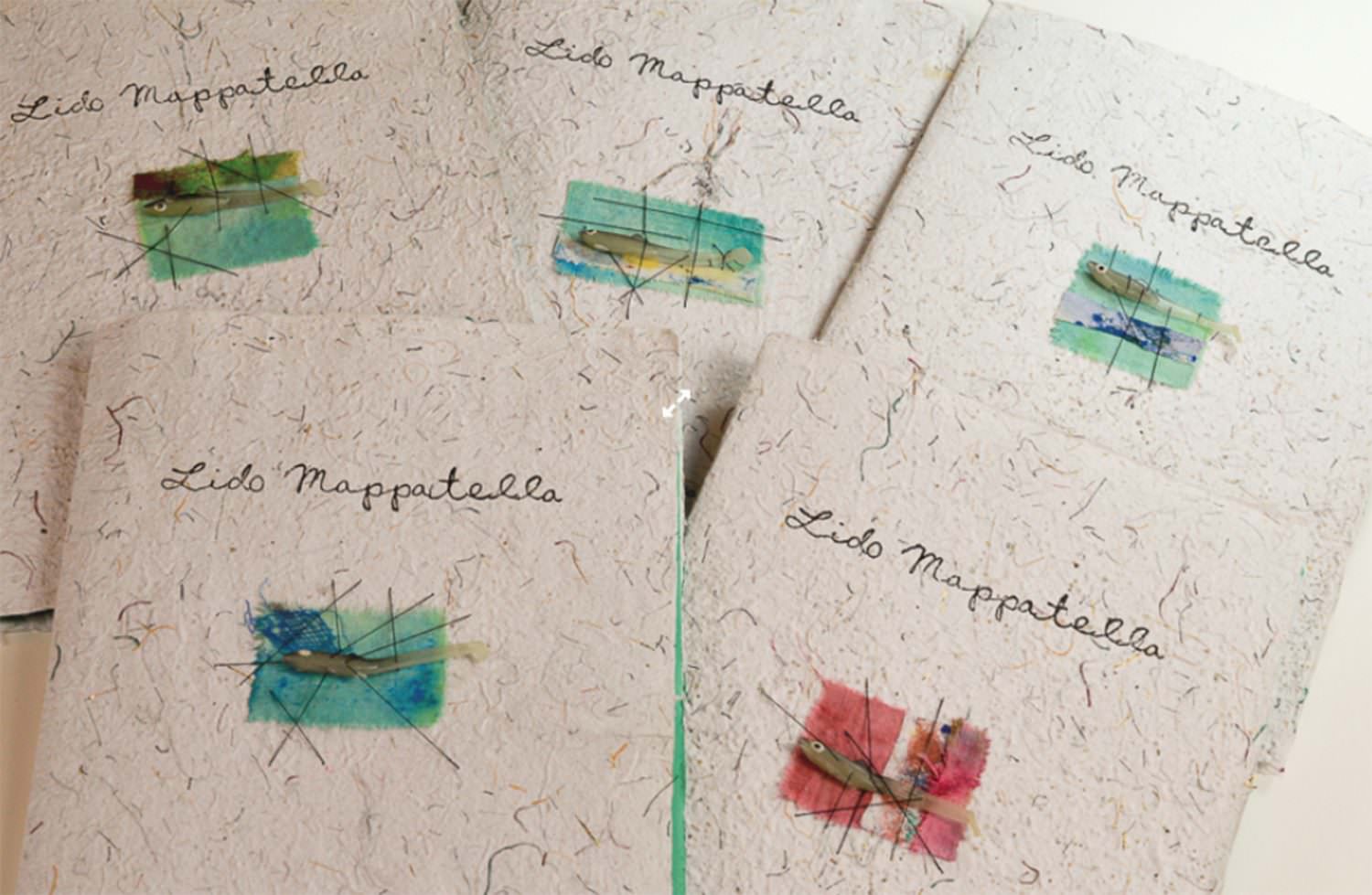
And Lido Mappatella with a handmade paper cover kneading cotton fibers with sands and ragged pieces. The text is by Enza Silvestrini printed on straw paper and with a unique copy portrait made by Enrico Pulsoni.

Then, “CUM GRANO SALIS” with texts by Luigi Trucco from a literary tale extracted by Nico Orengo and with 7 serigraph plates by Vincenzo Rusciano.

Tonia Limatola

My blog tonialimatola.wordpress.com
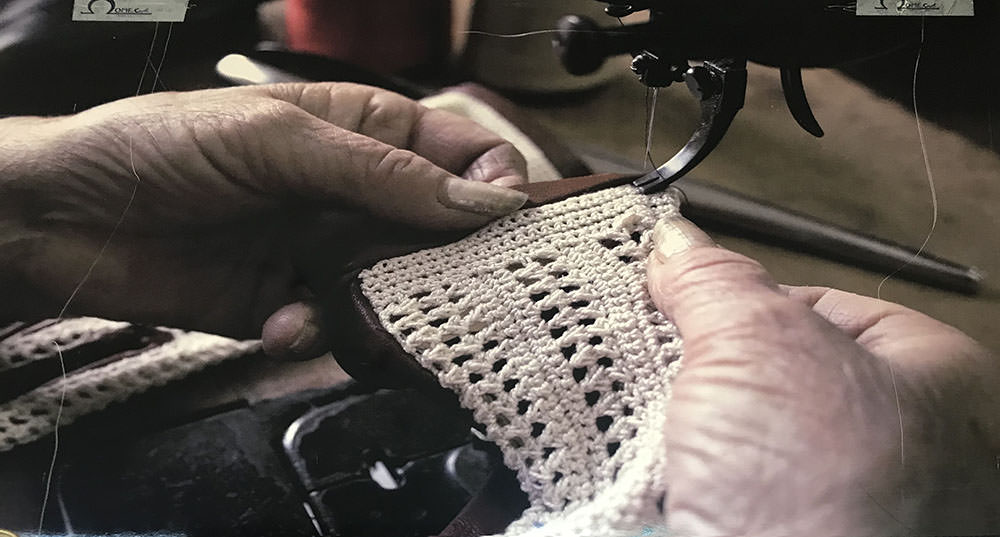
Working in a company like Omega is a bit like being teammates: in order to win the match, and make every day the best gloves in the world, you need that every team member gives his 100%.
When I visited Mauro Squillace’s manufactory, it was explained to me that these magnificent gloves need 25 different working phases in order to be made. It wasn’t this information to impress me, though.
Don’t misunderstand me: 25 phases are a lot. And if you calculate the manufacture of the raw leather too, it reaches over 30 phases. Incredible!
However, what actually hit me more than anything else was that all these working phases are made by as many workers.
Can you imagine it? The perfect assembly line.
Heritage

Moreover, Mauro told me something else: each of the ladies who work for Omega had her own ability in heritage. Her mother taught her how to sew, how to cut, how to handle the leather. And her grand-mother taught it to her mother! It’s an heritage jealously preserved, whose effects have repercussions on the entire district, on the whole city.
Because if it’s true that the glove manufactory in Naples is the best in the world, it is thanks to these ladies who handed down their work techniques to their daughters.
And if you have the luck to go and visit Mauro with esplora Napoli, he will perfectly explain to you:

Each of these ladies sews with her family technique and will never sew in any other way!

Can you understand what a treasure is it?

Who’d have thought that in the center of one of the folk districts of Naples, on the top floor of a dilapidated building, in a untidy and smoky office, there was such a manufactory…?
We always hear that Naples is a city with one thousand contradictions: I never found this expression so fitting like when I visited Mauro and Alberto Squillace’s laboratory.
Among the alleys of the Stella district, one of the most sadly known because of the chronicle facts, there is a specialized manufactory: one of the highest level ones in Naples.
What am I saying? Not “in Naples”, but in Italy.
Even better: in the world!
I’m not kidding, and absolutely I’m not going too far.
I challenge you to browse a fashion magazine coming from anywhere: Germany, US, France, Japan…
There is a huge chance that the gloves worn by the models in photos came from the Stella district, from that smoky office.
To be honest, not all the 25 working phases needed for the production of those fantastic gloves are made there: several shops and offices are spread all over Naples and its province, but you can be sure that every snippet of leather, every sewing, every complete pair of gloves will be checked one thousand times by the masterly look of Mauro, the boss.

Mauro Squillace, the first among his artisans

When you will come into the office of Omega thanks to esplora Napoli, you’ll be welcome by Mauro Squillace, the owner of Omega.
You will immediately realize how kind (and chatty) person he is; but you’ll also realize something else.
You’ll understand that he is not just the boss of the company his grand-father founded almost one hundred years ago, but he is also the leader of his artisans team.
He knows each of the 25 phases his magnificent gloves need, and he deals with the most tricky ones.
He’ll show you anything! And you will seriously understand how much labor, how much work and, above all, how much knowledge are required for a product touching the art piece.

That’s a question we often ask when we face a good artisan’s work.
A good carpenter, a good tailor, a good shoemaker, a good ceramist can make pieces of work so good to make us believe they are artworks.
But art is an important word; a tough one.
You can’t pronounce it lightly

So, when can you actually speak about art?

Can you do it when the artisan does his job with passion? Yes, but it’s not enough.
When the artisan puts his soul into his works? Yes, but it’s not enough.
When the artisan can use masterfully hard techniques, passed down to him for decades, or centuries? Yes, but once again that’s not enough.
In my opinion, handicraft raises to art when the artisan put into play something more than his ancient techniques.
It’s art when he keeps studying critically his works, learning from the past great artists’ works, and when he reworks what he can already do in order to create something absolutely unique.

Just one word: thinking

All this can be summed up with one word: thinking.
Thinking makes art different from handicraft.
An artisan, as far as he’s good, as far as he does have golden hands, is little more than a pure performer of techniques learnt in many hears of work.
And, of course, I’m not denigrating artisans work. Handicraft has always been fulcrum of civilities.
But an artist make a different job; more cerebral, more intellectual.
If you ask Ulderico Pinfildi what is his job, you will answer you

I’m an artisan, I make puppets.

But do yourselves a favor: go and visit his workshop with esplora Napoli, and you will understand how wrong he is.